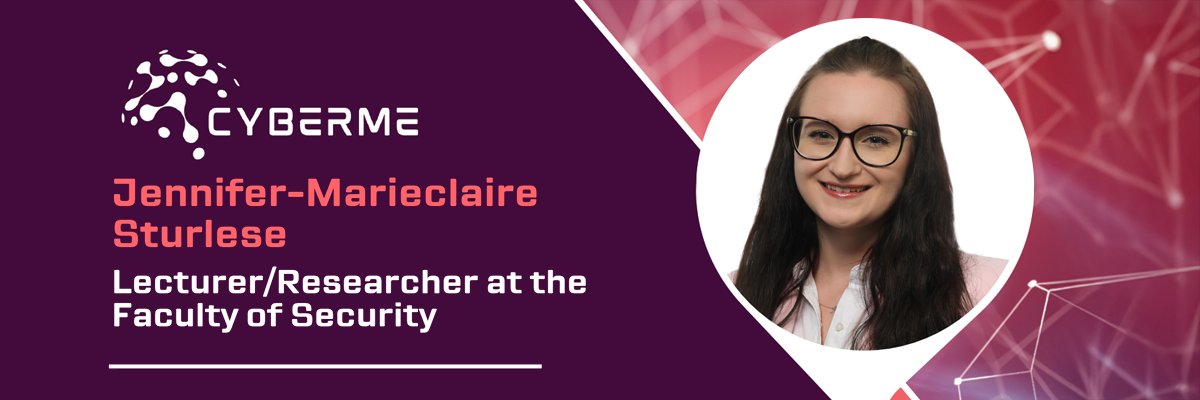
Role Model: Jennifer-Marieclaire Sturlese
Personal Details
- Title, Name, Surname: Jennifer-Marieclaire Sturlese
- LinkedIn Profile: https://at.linkedin.com/in/jmc-sturlese
- Personal webpage: https://scholar.google.com/citations?user=QGPCy2QAAAAJ&hl=de&oi=ao (Google Scholar)
https://orcid.org/0009-0004-4668-2534 (OrcID) - Link and information to any initiatives you are involved in that relate to empowering women in ICT: https://shedigital.at/shecurity/
Expertise
- Your role/job title: Lecturer/Researcher at the Faculty of Security
- Company name: FH Wiener Neustadt
- What is your field of expertise? Cybersecurity
Company details
- LinkedIn: https://at.linkedin.com/school/fhwienerneustadt/
- Facebook: https://www.facebook.com/fhwienerneustadt
- Link (and information) to any initiatives your company may lead that relate to empowering women in ICT: /
Introduction
Please tell us a few things about yourself.
My name is Jennifer-Marieclaire, and I am a researcher and lecturer and currently pursuing my PhD in Computer Science, specializing in security and privacy.
My path into Computer Science was different to a conventional IT path. I initially attended a business high-school and studied International Business. During my Master’s degree, I moved more towards Business Informatics and started working at the Department for Information at WU Vienna. This was the place where I really found my place to be, at the intersection of business and computer science.
Today, I combine my job at the university of applied sciences with my PhD studies. This is the optimal combination for me, as both allow me to pursue my overarching passion in cybersecurity.
Inspiration
What motivated you to enter the cybersecurity field, and how can we make that journey more accessible and visible to young women today?
I was always interested in Computer Science, but I initially did not see a clear connection between my business high-school and a career in IT.
A major turning point was the opportunity to work at the Department for Information Systems. My direct supervisor was a great woman who is a computer scientist in a senior position.
I think this role-model effect is very important for women. Computer Science still has a strong stereotype – the young man in a hoodie who codes or hacks. We need to show young people, already at school, that there are many different ways into Informatics and cybersecurity and that women are part of the field.
Career Growth
Beyond technical knowledge, which soft skills - such as teamwork, problem-solving, or ethical awareness - are most valuable in your day-to-day work?
For me, one of the most important soft skills is recipient-oriented communication. There is a specific language that IT professionals speak, but we constantly have to communicate with people from different backgrounds and with different stakeholders.
It is important to translate technical concepts into inclusive language and make sure that the message actually reaches the other person. It is not (only) about showing how much technical knowledge one has, but about communicating in a way that the other person can understand.
I think this is particularly important today because Informatics is no longer an isolated field. They are part of day-to-day life.
Memorable Achievements
Share a project or moment that reflects the impact of your work.
One experience that really stayed with me was participating in the Young Researchers Day at Austria’s national IKT security conference. Young researchers were given a couple of minutes on the main stage to present their results in front of a very large audience. For me, this was a great opportunity to present myself and my research. I also made professional contacts afterwards that I still have today. It showed me how valuable it is to give young researchers a platform and the opportunity to present themselves.
Another memorable experience was participating in a cybersecurity panel at the Austrian Computer Science Day.
Challenges
How do you stay ahead in a competitive field, and what obstacles have you overcome?
I would not necessarily describe it as “staying ahead”. I think it is more important to know where you want to see yourself and then how to get there in the most promising way.
You do not always have to follow the conventional path. For example, when I started my PhD, I could have waited for a sparse pre-doctoral position in cybersecurity. Instead, I chose to work at the university of applied sciences while pursuing my PhD externally.
This required some additional effort, but it allows me to reach the same target goal. For me, the important thing is that if the direct path is blocked, you do not have to give up on the goal. You can simply take a different route.
Work-Life Balance
How do you manage the demands of career and personal life?
Flexibility and trust are very important to me. I am very grateful that, both my manager at work and my PhD supervisor prioritize results and performance over rigid working hours.
Because I genuinely enjoy my work, I do not feel the need to completely segregate work and personal life. I try not to work on weekends, but during the week I appreciate being able to organize my time flexibly. For me, this is also part of long-term resilience.
Personal motive
What’s your personal motto, or favourite motivational quote, that can also inspire the younger generation to follow studies and a career in an ICT / cybersecurity field?
My motto would be “trust the process.” Especially with something as long-term as a PhD, you do not see a result at the end of every single day. You have to trust that every small step is still taking you in the right direction.
I think this is particularly important for young people who are considering entering Informatics or cybersecurity. Even if you later realize that the field is not for you, you have not wasted your time. You have gained skills and experience and learned something about yourself.
So, I think the first step should not be such a big hurdle. You can try it out and see where it takes you.
Future
Which emerging areas in cybersecurity, such as AI security, data protection, or social engineering, will be most relevant for the next generation of professionals entering the field? And what role can gender diversity and inclusion play?
I see two major challenges. For people who want to work in IT or cybersecurity, it is important not to skip the basics. With generative AI, AI agents and “vibe coding”, the barrier to entering Informatics has become lower, but professionals should still understand the fundamentals and what is happening behind the technology.
The second major challenge is cybersecurity awareness in society. Almost everyone today uses a smartphone or the internet and can therefore become a victim of cybercrime. Basic knowledge about phishing, passwords and online security should become as normal as basic safety advice in everyday life.
At the same time, not everyone who works in cybersecurity needs to be tech-savvy. There are many different career paths, for example, in cybersecurity awareness and training, where communication skills are very important.
I think the field needs to become much broader. The idea that you have to be very tech-savvy to work in Informatics might have been more relevant two decades ago, but today digitalization is part of everyday life. We need people with different skills and backgrounds.
Comments / remarks
My message to young women would therefore be: be brave, take the first step and trust the process. Even if you later realize that the field is not for you, you have not lost anything. You will have gained valuable skills and experience.
Sometimes the path to your goal is not the straight one, but that does not mean you cannot get there.