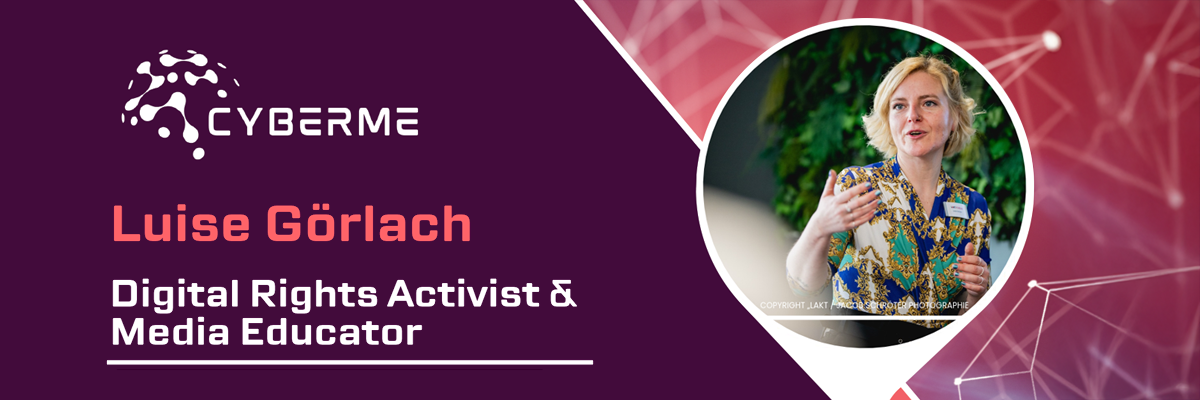
Role Model: Luise Görlach
Personal Details
- Title, Name, Surname: Luise Görlach
- LinkedIn Profile: Luise Görlach
- Personal webpage: luisegoerlach.de
- Link and information to any initiatives you are involved in that relate to empowering women in ICT: Haecksen (a feminist network associated with the Chaos Computer Club; https://www.haecksen.org/ ), advocacy against cyberstalking and digital violence (https://antistalking.haecksen.org/) ; workshops for women’s groups and professionals in the social sector (esp. those affected by digital violence)
Expertise
- Your role/job title: Digital rights activist, media educator and freelance trainer for digital self-determination, university lecturer for media psychology (IU)
- Company name: self-employed
- What is your field of expertise? Digital self-defense, data protection and IT security for the social and educational sector (with a focus on privacy, digital violence and responsible digitization), media psychology (focus on Dark Patterns)
Introduction
Please tell us a few things about yourself.
My name is Luise Görlach, and I work as a media educator and digital rights activist focused on digital self-determination. My path into the field was anything but linear: I studied psychology, educational sciences, development policy, cultural studies and design. At first glance these look like five unrelated subjects, but they share one common thread: the collection and exploitation of data. In every one of these disciplines I kept encountering the same questions: who gathers information about people, and what happens with it afterwards? How can data be used for good? And how is data used for harming people (that question eventually led to engaging in Cybersecurity).
Today I run workshops, talks and consultations on data protection and IT security as well as media psychology, mainly for the social and educational sector: teachers and parents, university staff, women's groups, associations, social workers, self-employed people and groups with international biographies as well as vulnerable groups such as refugees and activists. These are people who handle highly sensitive information about others every day and who are often left alone with the technical side of that responsibility. I also wrote a book on digital self-determination, contribute a regular tool column to a newsletter, and I am active in the Haecksen, a feminist network in the German hacker community, where I work on measures against cyberstalking and digital violence.
Inspiration
What motivated you to enter the cybersecurity field, and how can we make that journey more accessible and visible to young women today?
I did not arrive here through a computer science degree, but rather through people, curiosity and the search for cybersecurity seminars for women. In my work as an educator I kept meeting individuals who were affected by something they could not name: phishing, hacking, ransomware, unwanted tracking, accounts taken over by ex-partners, stalking that had moved from the street into the phone, or institutions that handled highly sensitive client data on platforms that were never designed for it. That is what pulled me in, and it is why I now work on digital violence and cyberstalking. I started by searching for women-led seminars on Cybersecurity and ended up doing it myself because there were none.
What I want young women to know is that the entry point does not have to be a firewall. Digital self-defence is often mistaken for hacking and deep technical expertise, when in fact it starts with everyday decisions: paying in cash instead of collecting loyalty cards, using a camera cover, asking "do I actually need this app?". None of that requires an IT degree, only a bit of attentiveness. Once people realise they already understand the underlying question, which is who knows what about me and why, the technical layer becomes far less intimidating.
To make the path more accessible, I would focus on three things. First, connect cybersecurity to real concerns rather than to abstract threat models: for many young women, protection from digital violence is a much more immediate motivation than corporate risk management. Second, make the non-linear routes visible: my own background is in psychology, educational sciences, development policy, cultural studies and design, and every single one of those perspectives is useful in this field. And third, learn together. Digital maturity is a team sport, not a solo achievement, and workshops where people can ask supposedly stupid questions without embarrassment do more for participation than any list of certifications.
Career Growth
Beyond technical knowledge, which soft skills - such as teamwork, problem-solving, or ethical awareness - are most valuable in your day-to-day work?
Translation is probably my most important skill. Not between languages, but between worlds. I spend a lot of my time turning technical realities into something a social worker, a teacher or a women's group can act on by Monday morning, and, just as often, turning people's actual concerns into requirements that IT departments can take seriously. Neither side is wrong; they simply speak different dialects. Anyone who can move between them is genuinely needed.
Closely connected to that is the ability to listen without judgement. When someone tells me they clicked "accept all", installed every app, and posted their holiday plans publicly, the worst thing I can do is make them feel foolish. Shame is the fastest way to make people stop asking questions, and in security, people who stop asking questions are the real risk. I would rather someone admit that they reuse the same password everywhere than pretend otherwise for the rest of the workshop. So generating an atmosphere of mutual respect is a key element for my workshops.
Then there is ethical awareness, which in my field is not an add-on but the substance of the work. I advise people and organisations that handle data about people in vulnerable situations. The question is rarely "is this technically possible?" and almost always "is this justifiable, and who carries the consequences if it goes wrong?". That requires a willingness to sit with uncomfortable answers, including the answer that a convenient tool has to go.
And finally: patience, plus a certain stubbornness. Digital self-defence is a marathon, not a sprint. Perfect security does not exist, and holding out for it paralyses people. I have learned to celebrate the small steps, like exchanging app X for app Y, because those are the changes that actually last.
Memorable Achievements
Share a project or moment that reflects the impact of your work.
One month. That is how long it took from founding my business to standing on a stage at the EMOTION Women's Day 2021. I had barely printed business cards, and suddenly I was invited to speak about digital self-defence in front of an audience of women who had come to think about their careers, their money, their health and, as it turned out, their data.
What made this moment memorable was not the stage itself. It was the realisation that there was a certain need for someone to talk about this topic in this particular way. There was no shortage of security experts in Germany. What was missing was someone addressing women directly, in plain language, about what actually happens to their information and what they can do about it on a perfectly ordinary Tuesday. The demand was already there. It had simply never been met. The response at that event is what set everything in motion. It confirmed that I was not filling a niche but an obvious, embarrassingly large gap, and it eventually led to my book on digital self-determination (“Digitale Selbstbestimmung: Jetzt!”, 2023, EMF Verlag). Writing it allowed me to reach far beyond the people who can attend a workshop in person, and it turned a series of individual conversations into something that people can pass on, lend out, and return to when they need it.
Whenever I doubt whether this work matters, I think back to that first month. If a newly founded one-woman operation gets invited onto a national stage within four weeks, the topic is not the problem. The silence around it was.
Challenges
How do you stay ahead in a competitive field, and what obstacles have you overcome?
The obstacle that comes up most reliably is being a woman in a field that still assumes expertise looks male. My competence tends to be treated as something I first have to prove rather than something people take as given. It is rarely hostile, more a reflex, a small extra hurdle before I am allowed to simply do my job. I used to respond by preparing even more thoroughly. Preparation does help, but I have stopped reading scepticism as a verdict on my work. It usually says more about people's expectations than about my expertise, and letting go of that saved me a lot of energy.
My background turned out to be an advantage rather than the gap I once thought it was. I did not come through computer science, and that is precisely why my workshops work: anyone can list security recommendations, but understanding why people ignore them requires knowing something about human beings. That is also the key to changing their behaviour, which is the main goal of my workshops. Women networks also really helped me to stay on track. I simply love the way women are encouraging and supporting each other, so I gain a lot of confidence and insights during network events.
Work-Life Balance
How do you manage the demands of career and personal life?
The irony of my job is that I spend my days telling people to put the phone down, and then work in a profession that lives on the screen. So I take breaks seriously: not as a reward for finished work, but as part of the work itself. Genuine breaks, without a screen, without "just quickly checking something". As a freelancer, approaches like time-boxing and co-working are really helpful ways to keep a healthy balance while staying social. Being self-employed means the boundary between work and life is mine to draw, which is both the freedom and the trap. I have learned that nobody else will schedule my downtime for me.
Also I engage in a lot of analogue hobbies and volunteer work. I recently starting teaching self-defense in a very analogue way by becoming a kickboxing instructor and founding a women’s class. Perfect combination :)
Personal motive
What’s your personal motto, or favourite motivational quote, that can also inspire the younger generation to follow studies and a career in an ICT / Cybersecurity field?
My favourite quote is by Marie Curie: "Nothing in life is to be feared, it is only to be understood." It has been on my website from the beginning, and it describes my entire approach to this work. Few subjects are as loaded with fear as IT security and data protection. People arrive at my workshops convinced that they are too late, too clueless, too non-technical, or they avoid the topic altogether because every headline suggests they have already lost. Fear is a terrible teacher. It makes people freeze, hand over responsibility to someone else, or click "accept all" simply to make the discomfort go away.
What dissolves that fear is understanding. Not complete mastery, not a certificate, just the moment when something that seemed like magic turns out to have a mechanism behind it. Once you grasp why an app wants your location or how social engineering usually unfolds, the question stops being frightening and starts being answerable.
Which brings me to my second conviction: everything is learnable, given someone explains it well. When people do not understand a topic, that is rarely a statement about their intelligence. It is far more often a statement about the quality of the explanation. Our field has a long tradition of explaining badly and then blaming the audience for it. I would rather assume that anyone can understand this, and treat the explanation as my responsibility, not theirs.
Future
Which emerging areas in cybersecurity, such as AI security, data protection, or social engineering, will be most relevant for the next generation of professionals entering the field? And what role can gender diversity and inclusion play?
The area I would point young people towards is the intersection of surveillance and everyday technology. Data protection is not becoming less relevant, it is becoming more and more political. State access to private communication, biometric systems in public space, the merging of commercial and governmental databases: these are no longer hypothetical scenarios. Anyone entering this field now will spend their career on questions that are as much about democracy as about technology.
AI amplifies all of it. Systems trained on personal data make inferences that people never disclosed and often cannot contest. Micro-targeting turns advertising into psychological influence. Deepfakes make social engineering vastly more effective, and are used overwhelmingly against women. The next generation will need to understand not just how these systems work, but who they work against.
That is precisely where diversity stops being a nice-to-have. Threat models reflect the people who write them. Teams that have never experienced stalking, harassment or coercive control tend to design for the attacker they can imagine: an external stranger after valuable data. They routinely miss the far more common scenario in which the attacker is someone with legitimate access: a partner, a family member, a colleague. Shared-device settings, location features, "find my friends" functions: these are built with trust as the default assumption, and that assumption fails exactly where the risk is highest.
More women in Cybersecurity means these attack scenarios get taken seriously earlier, not because women are inherently more empathetic, but because different life experiences produce different questions. And in a field whose entire purpose is anticipating what could go wrong, a narrow range of questions is a genuine security weakness. More women in this field also means more products that identify the potential for misuse in advance and counteract it.
There’s amazing potential and I am so much looking forward to women creating products and solutions based on their perspective on the world.