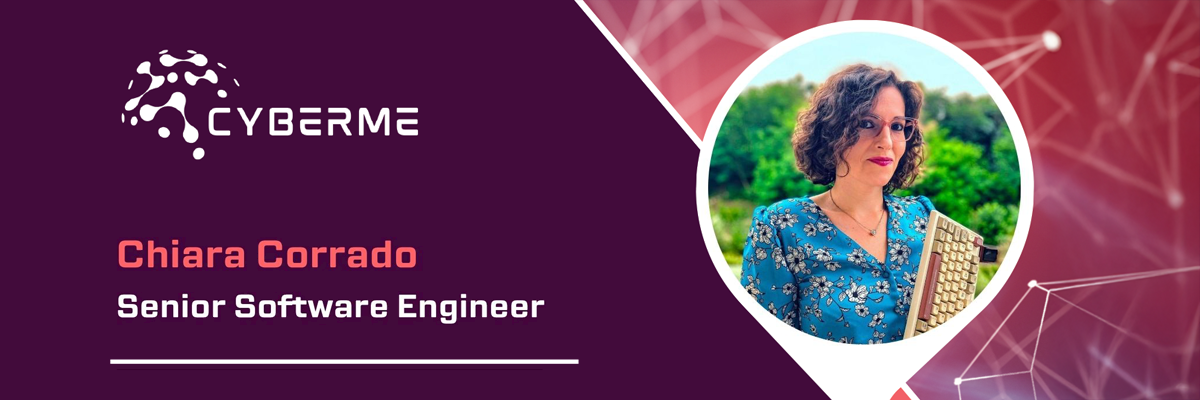
Role Model: Chiara Corrado
Personal Details
- Title, Name, Surname: Chiara Corrado
- LinkedIn Profile: https://www.linkedin.com/in/chiaracorrado/
- Personal webpage: https://chiaracorrado.dev/
- Facebook: https://www.facebook.com/chiara.corrado.9699/
- Link and information to any initiatives you are involved in that relate to empowering women in ICT:
- https://www.technovation.org/women-techmakers/ since 2018
- https://djangogirls.org/en/pyconitalia/ since 2019
- https://shetechitaly.org/ since 2024
- https://donne4.it/ since 2025
- https://www.greensoftwareitalia.org/ (ESG in tech) since 2025
Expertise
- Your role/job title: Senior Software Engineer
- Company name: Aruba
- What is your field of expertise? Backend, SW Architecture, Sustainability
Company details
- LinkedIn: https://www.linkedin.com/company/aruba-s-p-a-/
Introduction
Please tell us a few things about yourself.
I am a Senior Software Engineer at Aruba Software, where I mainly work on integrations, backend engineering, APIs, and secure digital services. Over the years, I have worked on software development, automation, distributed systems, and platform integrations, with a strong interest in system architecture and in how technology, scalability, and maintainability can successfully coexist over time.
Alongside my technical work, I am very active in communities and initiatives focused on inclusion in STEM. I am a Women Techmakers Ambassador, I collaborate with several organizations that support women in technology, and I am co-founder of Green Software Italia, a community that promotes a more sustainable and responsible approach to software and digital systems.
What motivates me most is the idea that technology is never neutral: the systems we build influence people, opportunities, and accessibility. That is why I care not only about innovation and performance, but also about ethics, inclusion, and social impact.
Inspiration
What motivated you to enter the cybersecurity field, and how can we make that journey more accessible and visible to young women today?
What first brought me closer to cybersecurity was curiosity. I have always been fascinated by understanding how systems work, where they can fail, and how trust is built within digital infrastructures. Security lives at the intersection of technology, responsibility, human behavior, and critical thinking.
Over time, I also realized that cybersecurity is not only about protecting systems, but about protecting people as well. Digital identity, privacy, access to services, and digital rights are human topics before they are technical ones.
For many young women, however, the hardest part is not learning technology. It is feeling legitimate in those spaces. Sometimes you walk into a university classroom, a conference, or a tech environment and you feel “different” even before speaking.
I believe visibility matters enormously. Seeing women working in cybersecurity, cloud, or engineering transforms something abstract into something possible. Mentorship, inclusive communities, accessible events, and role models are essential, but we also need to normalize imperfection. You do not need to know everything before starting. In this field, we are all still learning.
Career Growth
Beyond technical knowledge, which soft skills - such as teamwork, problem-solving, or ethical awareness - are most valuable in your day-to-day work?
Technical skills are fundamental, but they are rarely enough on their own. In my daily work, communication is probably one of the most important skills. Complex systems are built by teams, not by individuals, and being able to explain technical concepts clearly helps prevent major misunderstandings later on.
Problem-solving is also essential, especially when working with distributed systems, integrations, and architectures involving many different components. Often, the challenge is not only solving the technical issue itself, but understanding the broader system around it and the long-term consequences that a decision may have.
I also believe that ethical awareness is becoming increasingly important in the tech world. Today, engineers influence infrastructures, AI systems, digital identities, data protection, and large-scale automation. We should ask ourselves not only “Can we build it?”, but also “Should we?” and “What consequences will it have?”
Finally, I think empathy matters much more than people realize. Good engineering is not only about writing efficient code: it is about creating systems that other human beings can understand, maintain, and use safely.
Memorable Achievements
Share a project or moment that reflects the impact of your work.
One of the moments I am most proud of is not tied to a single feature or release, but to the impact on people.
Over the past few years, I started speaking publicly at conferences and tech events, despite having been afraid of public speaking for a long time. I began by writing online in spaces that felt like they were read by very few people, and then slowly moved into organizing events, mentoring, moderating panels, and speaking about technology, inclusion, sustainability, and women in STEM.
What stayed with me the most were not the talks themselves, but the moments afterward, when someone would tell me: “I felt less alone.”
That sentence changed the way I see impact in tech. Sometimes the most important thing we build is not only software, but spaces where people feel they truly belong and are allowed to exist.
Challenges
How do you stay ahead in a competitive field, and what obstacles have you overcome?
Technology evolves very quickly, so continuous learning becomes part of everyday life. I try to stay up to date through hands-on experimentation, open-source projects, technical communities, conferences, and discussions with other professionals.
But honestly, one of the biggest challenges has been more internal than technical. Like many women in tech, I often felt the need to prove myself more before feeling allowed to take space, speak publicly, or consider myself sufficiently prepared.
Over time, I understood that confidence in this field does not arrive all at once. It grow through experience, community, and sometimes simply by continuing despite discomfort.
Another challenge is finding the balance between depth and breadth. Modern cybersecurity and cloud ecosystems are huge: it is impossible to know everything. That is why learning how to collaborate, ask questions, and adapt becomes essential.
Work-Life Balance
How do you manage the demands of career and personal life?
I am still learning, honestly.
The tech world can easily become all-consuming, because innovation never stops and community work often continues beyond regular working hours. Over time, I realized that sustainability also applies to people, not only to systems.
I try to protect moments that reconnect me with the physical world: nature, walks, travel, the people I care about, and activities that help me slow down mentally. Setting boundaries is important, especially in remote and hyperconnected environments.
I also believe that balance is not a fixed state. Some periods are more intense than others.
The important part is recognizing when it is time to recover energy before burnout becomes normalized.
Personal motive
What’s your personal motto, or favourite motivational quote, that can also inspire the younger generation to follow studies and a career in an ICT / Cybersecurity field?
There is a sentence that stays with me deeply: “Fear does not disappear. It simply stops occupying the whole room.”
I love it because people often think that confidence means having no fear, especially in technical careers. In reality, much of our growth happens while we still feel uncertain.
You do not need to be perfect to enter STEM or cybersecurity. What you need is curiosity, consistency, and the courage to keep learning even when you feel out of place.
Sometimes representation begins exactly there: with someone deciding to take space despite the fear.
Future
Which emerging areas in cybersecurity, such as AI security, data protection, or social engineering, will be most relevant for the next generation of professionals entering the field? And what role can gender diversity and inclusion play?
AI security will definitely be one of the central topics of the coming years, especially regarding model integrity, data governance, misinformation, prompt injection, and autonomous systems.
I also believe that threats related to the human factor, such as phishing and social engineering, will continue to grow, especially with the evolution of generative AI. Today, these attacks have become much harder to detect: fake emails, messages, and content can be extremely realistic, personalized, and convincing. This completely changes the way we think about security, because it is no longer enough to recognize an obvious mistake or suspicious language. What we need is greater cultural awareness, not only technical awareness.
Data protection, digital identity, cloud security, supply-chain security, and infrastructure sovereignty will also become increasingly strategic topics, especially in Europe.
I believe cybersecurity cannot truly evolve in a healthy way if it remains homogeneous. Security also depends on perspectives: on who designs systems, which experiences they bring with them, and which risks they are able to imagine. Teams made up of people with diverse backgrounds are more likely to identify blind spots, implicit assumptions, or vulnerabilities that overly uniform groups might overlook. In this sense, inclusion and diversity are not only social values, but elements that concretely improve the quality and resilience of the technology we build.
Inclusion is not only a social value: it tangibly improves the quality of the technology we create. The future of cybersecurity will need not only safer systems, but also more diverse voices helping to shape them.