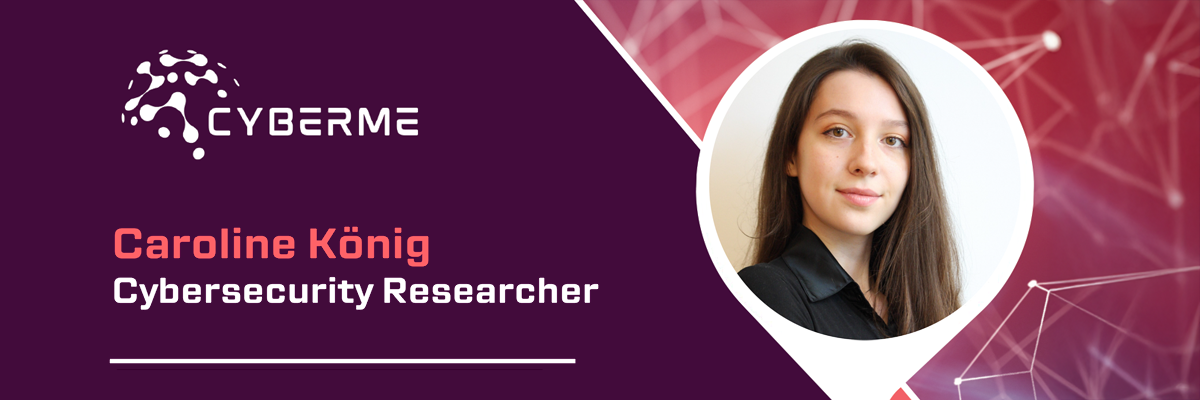
Role Model: Caroline König
Personal Details
- Title, Name, Surname: Caroline König
- LinkedIn Profile: https://www.linkedin.com/in/caroline-k%C3%B6nig-1b84a5224/
Expertise
- Your role/job title: Researcher in the Security and Privacy Research Group at the University of Vienna, with research activities at SBA Research in the CORE Research Group
- Company name: University of Vienna & SBA Research
- What is your field of expertise? Cybersecurity Research with a focus on Software Protection, Software Security, and Privacy.
Introduction
Please tell us a few things about yourself.
I originally studied Philosophy, specializing in the philosophy of technology. My interest in technology grew during my studies, and I wanted to better understand how technology actually works. This led me to learn computer science, and I eventually became a software developer. My first role in IT was in software development for a software testing company, where I was already exposed to topics related to software quality and security. Later, I joined a cybersecurity research team after meeting my current project leader, which marked my transition into cybersecurity. Today, I work as a Researcher in the Security and Privacy Research Group at the University of Vienna under Dr. Sebastian Schrittwieser, while also completing a Master's degree in Machine Learning at Johannes Kepler University (JKU). I have now been working in cybersecurity research for about four years and am currently involved in a larger research project focusing on software protection. Although my academic background is unconventional, I find that many skills from philosophy, such as critical thinking and analytical reasoning, are highly valuable in cybersecurity research. While the subject matter is different, philosophy taught me to analyze complex problems, question assumptions, and approach challenges from different perspectives - skills that continue to benefit my research today.
Inspiration
What motivated you to enter the cybersecurity field, and how can we make that journey more accessible and visible to young women today?
My path into cybersecurity happened rather unexpectedly. After working in software testing, where I was already exposed to security-related topics, I joined a newly established cybersecurity research team because I found the work exciting and diverse. I decided to give it a try and quickly discovered that I enjoyed the constantly evolving challenges. What attracted me most was that cybersecurity is a field where no two days are the same. There are always new problems to solve, new technologies to explore, and new threats to understand, which makes the work intellectually stimulating. To encourage more young women to enter the field, I believe it is important to make cybersecurity more visible, approachable, and open to people from different educational backgrounds. Many people assume they need a traditional computer science background to get started, but my own experience shows that different academic paths can also lead to successful careers in cybersecurity.
Career Growth
Beyond technical knowledge, which soft skills - such as teamwork, problem-solving, or ethical awareness - are most valuable in your day-to-day work?
Curiosity is one of the most important qualities in cybersecurity. Enjoying puzzles, experimenting, and solving problems is essential because every challenge is different. Communication and teamwork are equally important, especially when collaborating on complex research projects. Flexibility and the ability to think from different perspectives are also valuable. My background in philosophy has helped me approach problems creatively and consider alternative viewpoints, which is a significant advantage in research. Cybersecurity research often involves trial and error, where experimentation and persistence are just as important as technical expertise. Being willing to test ideas, learn from failures, and continuously adapt is an essential part of the job.
Memorable Achievements
Share a project or moment that reflects the impact of your work.
Rather than one defining achievement, many smaller experiences have been meaningful. One of my highlights was participating in a Science Slam during the Long Night of Research, where I explained complex cybersecurity research in just three minutes to a general audience. I particularly enjoy communicating research outside academia, presenting at conferences, seminars, and industry events, and showing people why software protection and cybersecurity matter in everyday life.
Challenges
How do you stay ahead in a competitive field, and what obstacles have you overcome?
I have been fortunate to work in a highly supportive team, where colleagues and supervisors encourage professional development and create opportunities such as conference presentations and public outreach. Although balancing my job with a master's degree can be demanding, the overlap between my studies and research makes it manageable. Having supportive colleagues and a positive work environment has been one of the biggest factors in overcoming challenges. Rather than seeing the field as highly competitive, I have experienced cybersecurity research as a collaborative environment where knowledge sharing and teamwork are strongly encouraged. The support of my colleagues has made it much easier to develop professionally while continuing my education.
Work-Life Balance
How do you manage the demands of career and personal life?
Balancing work and studies can be stressful, especially during the semester. I have learned that it is important to step away from the computer regularly, as both work and university involve spending long hours in front of a screen. Spending time outdoors, meeting friends, and disconnecting from digital devices helps reduce stress and maintain a healthy work-life balance. I have found that spending time in nature or simply taking a walk is one of the most effective ways to recharge and maintain my well-being during busy periods.
Personal motive
What’s your personal motto, or favourite motivational quote, that can also inspire the younger generation to follow studies and a career in an ICT / Cybersecurity field?
My advice is simple: don't be afraid to try something new. I entered cybersecurity from a completely different field and had to rebuild my mathematical knowledge after years away from it. It was challenging but far less intimidating than I expected. You do not need a traditional technical background to succeed. Communities, workshops, and initiatives such as Women for Cyber provide excellent opportunities to explore cybersecurity. If you are interested, give it a chance - you can always change direction later, but you might discover a career you truly enjoy. Many people hesitate because they believe they lack the necessary knowledge or experience. However, learning is part of the journey, and it is never too late to develop new skills. Even if you decide that cybersecurity is not the right fit, trying it will always be a valuable learning experience.
Future
Which emerging areas in cybersecurity, such as AI security, data protection, or social engineering, will be most relevant for the next generation of professionals entering the field? And what role can gender diversity and inclusion play?
Data protection will become increasingly important, especially with the rapid adoption of artificial intelligence. AI systems often process sensitive personal and corporate data, making privacy and data security critical concerns. AI security, privacy, and data protection are closely interconnected, and future cybersecurity professionals will need to understand how these areas influence one another.
Greater diversity is essential because different perspectives help identify security risks that might otherwise be overlooked. For example, women are disproportionately affected by malicious deepfakes, particularly non-consensual explicit content, yet these risks are often underestimated in broader AI risk discussions. Increasing gender diversity in cybersecurity ensures that a wider range of real-world experiences is represented, leading to more comprehensive research, better security solutions, and more inclusive technology policies.