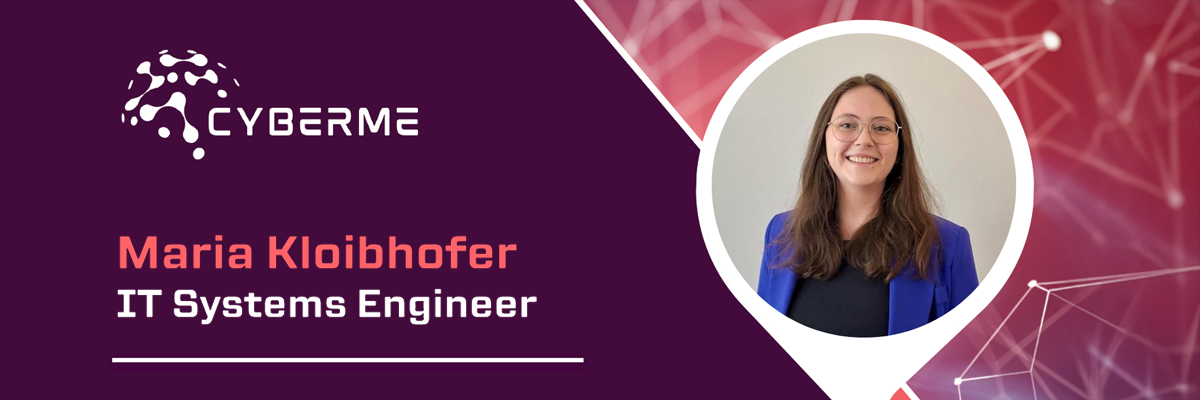
Role Model: Maria Kloibhofer
Personal Details
- Title, Name, Surname: Maria Kloibhofer, BSc.
- LinkedIn Profile: linkedin.com/in/maria-kloibhofer-22586a251
- Link and information to any initiatives you are involved in that relate to empowering women in ICT: https://www.linkedin.com/company/shecurity-women-in-security/ https://verbotengut.at/allgemein/hackerinnen-training/ (“Shecurity, connecting and empowering women in security through a strong community and capacity-building.” For example, they are offering free cybersecurity trainings for women* with a low barrier of entry.)
Expertise
- Your role/job title: IT Systems Engineer
- Company name: Waagner-Biro Austria Stage Systems GmbH
- What is your field of expertise? Information Security, Security Management, and Security Awareness, with a background in IT infrastructure, system administration, and implementing security solutions such as SIEM and EDR.
Company details
Introduction
Please tell us a few things about yourself.
I have been interested in cybersecurity since childhood, although I did not realize at first that this was what I was passionate about. I started my career through Austria’s dual vocational training system in IT while also completing my high school diploma. Later, I earned a Bachelor’s degree in IT Security and am currently pursuing a Master’s degree while working as an IT Systems Engineer in Vienna. My role combines IT infrastructure with information security management.
Inspiration
What motivated you to enter the cybersecurity field, and how can we make that journey more accessible and visible to young women today?
My motivation was simply a strong interest in technology. During my apprenticeship, I attended a short introduction to cybersecurity and immediately knew this was the field I wanted to work in. Although I experienced some gender-related stereotypes and was often one of only a few women in my classes, I never considered giving up. For example, customers would sometimes ask to speak to "someone from technical support," not realizing that I was the technician they were looking for.
To encourage more young women, I believe visibility, networking opportunities, communities, and female role models are essential, especially for those who may otherwise feel isolated. Being able to connect with other women who have had similar experiences would have made a significant difference early in my career. I believe that initiatives promoting exchange, mentoring, and visibility are crucial for helping young women feel that they belong in the field.
Career Growth
Beyond technical knowledge, which soft skills - such as teamwork, problem-solving, or ethical awareness - are most valuable in your day-to-day work?
Communication is one of the most important skills. Cybersecurity professionals need to explain technical concepts in a way that management and employees understand. It is important to help people see the value of security measures, such as multi-factor authentication, rather than viewing them only as an inconvenience. Acting as a translator between technical and business perspectives makes collaboration much more effective.
Memorable Achievements
Share a project or moment that reflects the impact of your work.
One of my first major projects was developing and delivering a cybersecurity awareness campaign within my company. I created training sessions based on real phishing emails that employees had received and organized everything myself. It was rewarding to see colleagues actively participate, ask thoughtful questions, and become more engaged with cybersecurity. This experience strengthened both my confidence and my passion for cybersecurity awareness and education.
Challenges
How do you stay ahead in a competitive field, and what obstacles have you overcome?
Early in my career, I often felt that I had to prove my competence as a young woman working in IT. I overcame this by focusing on professionalism, a positive attitude, and helping people see IT as an enabler rather than an obstacle. Rather than accepting the stereotype that IT only creates restrictions and security policies, I worked to build trust by showing that IT exists to support people and enable better ways of working.
Fortunately, I have noticed increasing awareness and support within both higher education and the workplace, making these challenges less significant over time.
Work-Life Balance
How do you manage the demands of career and personal life?
Balancing work and studying is manageable because I benefit from a flexible employer and the ability to organize my studies independently. The most important factor is managing my own energy and recognizing when I need breaks. I believe maintaining a healthy work-life balance requires self-awareness and taking responsibility for your own well-being.
Personal motive
What’s your personal motto, or favourite motivational quote, that can also inspire the younger generation to follow studies and a career in an ICT / Cybersecurity field?
My personal motto is “Don’t overthink it - trust yourself and take the next step”. It reminds me to face challenges despite feeling nervous. I would also encourage young people to find mentors, communities, and learning opportunities because cybersecurity is much easier to explore when you learn alongside others rather than trying to figure everything out alone.
Cybersecurity is a very broad and specialized field and trying to learn everything independently can be overwhelming. Joining webinars, introductory courses, or existing communities makes it much easier to discover different areas and find what genuinely interests you.
Future
Which emerging areas in cybersecurity, such as AI security, data protection, or social engineering, will be most relevant for the next generation of professionals entering the field? And what role can gender diversity and inclusion play?
Artificial intelligence will continue to shape cybersecurity, both as a powerful tool and as a challenge. While AI can support learning and productivity, it is important that newcomers still develop fundamental problem-solving and troubleshooting skills. I also believe that understanding regulations and compliance will become increasingly important. Finally, greater diversity and inclusion will strengthen the cybersecurity industry by bringing different perspectives, improving collaboration, and creating more innovative and well-rounded solutions. I think the industry benefits when people from different backgrounds and disciplines work together and understand each other's perspectives.
I also believe that many women are encouraged from an early age to think holistically, listen carefully, consider different viewpoints, and take the needs of others into account. These qualities are real strengths in cybersecurity, where communication, collaboration, and understanding the broader impact of security decisions are essential. I would love to see many more women entering the profession because I believe companies, and the industry, would benefit enormously from greater gender diversity.
Comments / remarks
My advice is simple: just try it. Cybersecurity is an incredibly broad field with many different specializations. If one area is not the right fit, it does not mean cybersecurity is not for you. Some areas require more technical problem-solving, while others focus more on communication, governance, awareness, or working with people. Because the field is so diverse, everyone has the opportunity to find a role that matches their strengths and interests.
Explore different topics through webinars, courses, or communities until you find the area that truly interests you. Greater visibility of the many career paths within cybersecurity will also help attract more diverse talent to the profess